
TCH Animal Health LLP Thomas C Hemling, Ph.D.
180 E Loch Lloyd Parkway, Village of Loch Lloyd, MO 64012
PeraSpray™ for Peracetic Acid Cluster Disinfection
Mastitis remains a major health and economic issue for dairy farms. Cow to cow transfer of mastitis pathogens via the milking unit is a risk factor for mastitis on both conventional and robotic milking installations. In conventional milking cluster disinfection between cows has been demonstrated effective for reducing mastitis risk. Success of cluster disinfection is a result of the practice implemented and by disinfectant used. Widespread use of cluster disinfection has been hampered by difficulties in implementing a consistent routine. Cluster disinfection has been done mainly by: a) cluster dunking; b) automated backflush; or c) cluster spraying. For a) the cluster is submerged in a bucket of disinfectant. This can be problematic because the solution eventually gets contaminated with soil from both the internal and external surfaces of the cluster and thereby loses its effectiveness. Also, care is needed to insure the disinfectant solution contacts the important internal surfaces. b) Automated backflush uses fresh disinfection solution and contacts only the internal surface, but equipment reliability and maintenance have been issues. Also cost for equipment in conventional systems can be prohibitive. C) historically manual spraying of the cluster via a drop hose with disinfectant has been utilized and provides fresh disinfection of the cluster, but the standard drop hose is not optimized for applying the solution to the internal surface of the liner, and materials compatibility is often not optimized.
The recently developed PeraSpray™ system provides a convenient and cost effect means of spraying the internal surface of the liner with fresh disinfecting solution. PeraSpray™ was designed and optimised to provide ease of use and to effectively spray the internal liner surface. It is designed to be compatible with today’s disinfectants of choice.
The disinfectant used must be fast acting, broad spectrum, compatible with the application equipment and the rubber liner, not create a milk residue concern, and be cost effective. Historically iodine was shown effective when used at low concentrations (12-25 ppm) but clogging of automated mixing equipment, and staining were sometimes problematic. Peracetic (PAA) as is today widely used for cluster disinfection at 125 – 250 ppm (more on this later), as it is broad spectrum and rapid acting and does not have the staining or mixing issues of iodine. We will explain more on the proper use of PAA with PeraSpray™ for cluster disinfection.
- What is Peracetic Acid?
- PAA is a broad-spectrum hard surface disinfectant, that is broadly accepted as the preferred product for use on food contact surfaces.
- PAA disinfectant is a mixture of peracetic acid, acetic acid (vinegar) and hydrogen peroxide.
- It is available as a concentrated 5% (50,000 ppm) liquid solution that is easily diluted for use.
- Safety and Handling of Peracetic Acid
- PAA in the concentrate is an oxidizing composition and has a low pH.
- It can be hazardous to skin and eyes.
- Appropriate personal protective equipment should be worn when handling PAA.
- Refer to the suppliers Safety Data Sheet for details.
- Why is PAA acceptable for use on food contact surfaces like the milking cluster?
- Upon use any residual will PAA will break down initially to acetic acid (vinegar)and hydrogen and will further break down to water, oxygen and carbon dioxide.
- PAA is approved in many countries for use without a post rinse.
- What concentration of PAA should I use?
- In each country regulatory authorities will establish levels of PAA that is safe and effective?
- Review the label of PAA from the specific product you intend to purchase.
- In the UK and in most EU countries PAA is diluted to 250 ppm for use of food processing equipment.
- In the USA, Canada…. PAA is diluted to 125 ppm (90 -190 ppm) for use on food processing equipment.
- Some product labels give a range of allowed PAA concentration depending on the contact time of the disinfectant on the surface of the equipment. The allowed PAA concentration may vary depending on the contact time. The shorter the contact time the higher the concentration. (example)
TP4 – Disinfection of milking equipment
0.60% (300 ppm) 20 ° C, 15 sec. CIP and soaking
0.24% (120 ppm)20 ° C, 30 sec and 5min by CIP and soaking.
- Can I use greater than 250 ppm concentrations of PAA with PeraSpray™?
- No. PAA can penetrate certain plastic materials and cause degradation, and 250 ppm of PAA has been shown effective.
- PeraSpray components are designed and tested to be compatible with up to 250 ppm of PAA. Higher levels of PAA will potentially damage seals and gaskets and will void the warranty.
- How do I prepare a solution of PAA?
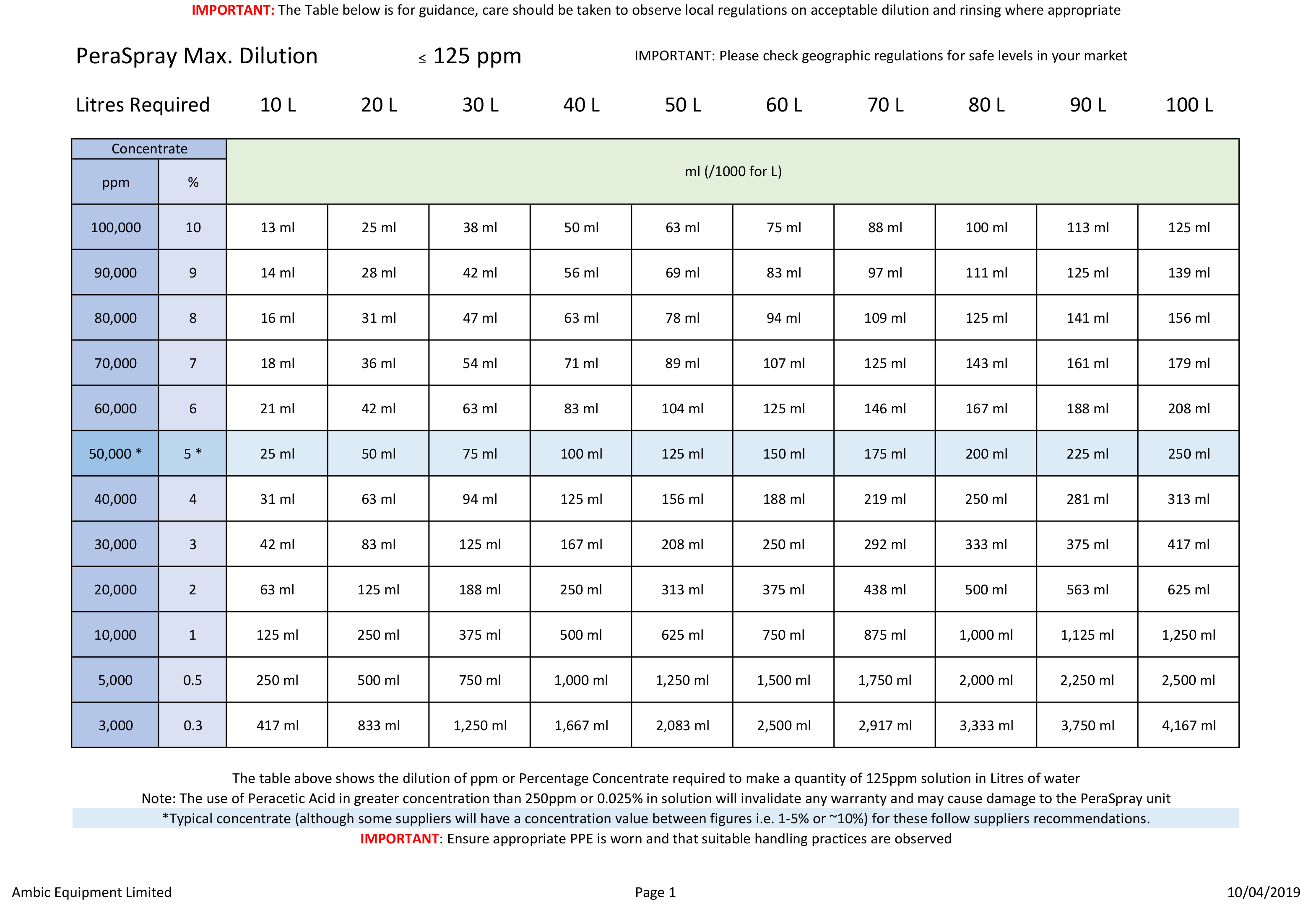
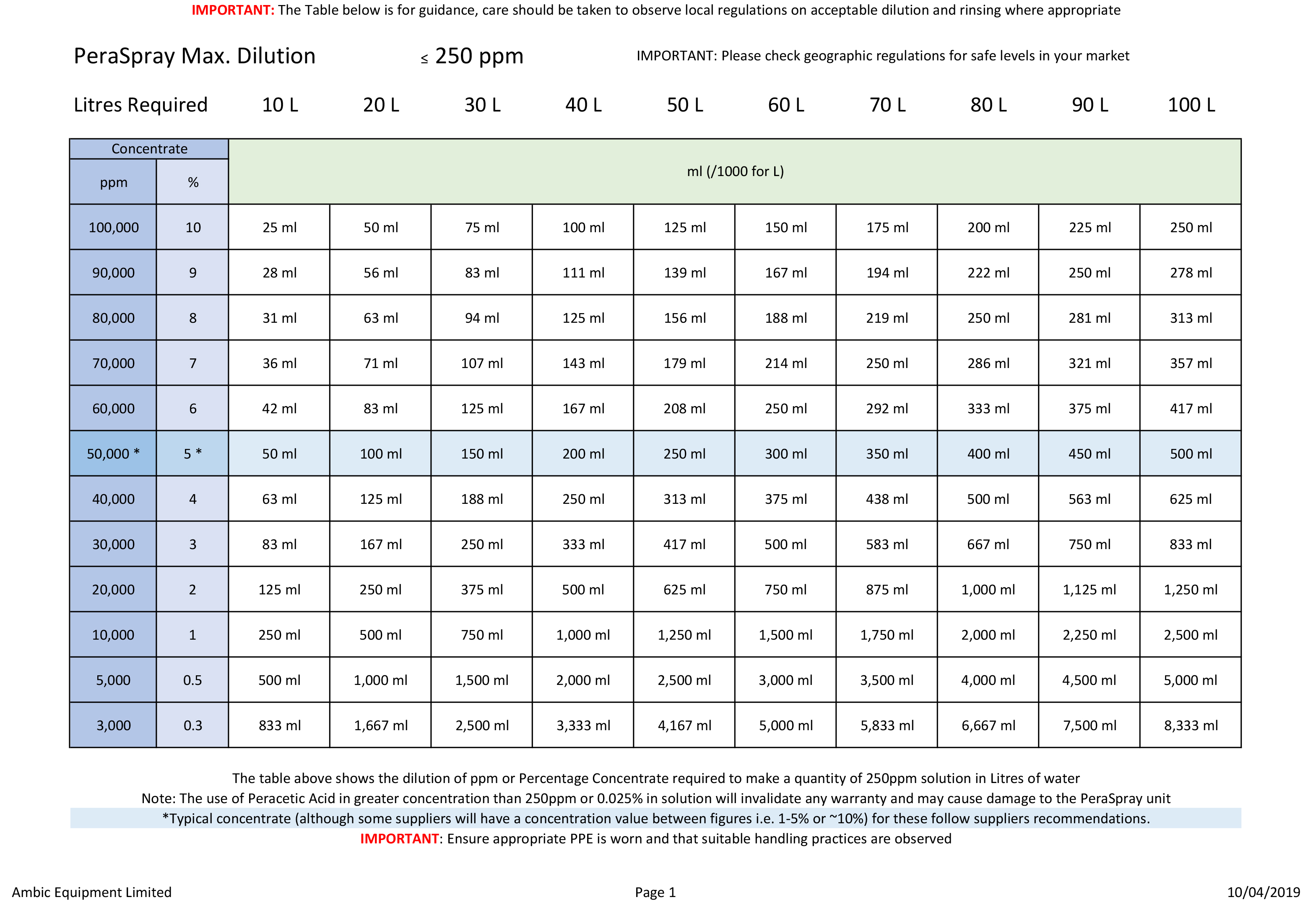
- PAA is purchased as a concentrate typically containing 5% (50,000 ppm) or 15% (150,000 ppm). 5% is most commonly used on dairy farms
- When using a 5% peracetic
- For 250 ppm.
- Add 50 ml of 5% PAA to 10 L of cold water.
- For 125 ppm.
- Add 25 ml of 5% PAA to 10 L of cold water.
- How long can I keep the dilute use-solution of PAA?
- Once diluted peracetic acid will gradually revert back to hydrogen peroxide and acetic acid.
- It is recommended that use-solutions (125-250 ppm) be held for not more than 12 hours.
- How do I use a PAA solution with PeraSpray™?
- Rinse the liners with water.
- With the cluster hanging vertically, place the PeraSpray™ nozzle in the liner opening and spray for 1 second in each liner.
- Let the cluster drain.
- If required by the PAA product label, after 15-30 seconds, post rinse with potable water to eliminate any product residue.
- Post rinse is suggested on most European product labels, but is not allowed on USA PAA product labels.
- Is PAA proved effective for cluster disinfection?
- Several studies have been recently conducted to demonstrate the efficacy of PAA in cluster disinfection. Here are two examples that show similar levels of efficacy for use of PAA cluster disinfection.
- Goossens, X. et al. compared 250 ppm PAA disinfection of liners with water rinse only. Before and after bacteria counts were determined by swabbing the internal surface of the liner. (2010).
Treatment Bacterial Count % Reduction Before After PAA 5462 59 98.9% Water Rinse 9246 1958 78.8% - Hiley, R. et al. investigated the use of 250 ppm of PAA with the PeraSpray system. Bacteria counts were taken before and after use of the PAA flush. (British Mastitis Conference 2010
Treatment Bacterial Count % Reduction Before After PAA – mean values 30562 268 99.1% PAA – median values 12425 95 99.2%
- Can I use other disinfectants with PeraSpray™?
- PAA is the recommended option because of proven efficacy, compatibility, cost and no milk or environmental concerns.
- See your PeraSpray™ dealer for details on how to use these germicides.